Shoulder Impingement
Overview
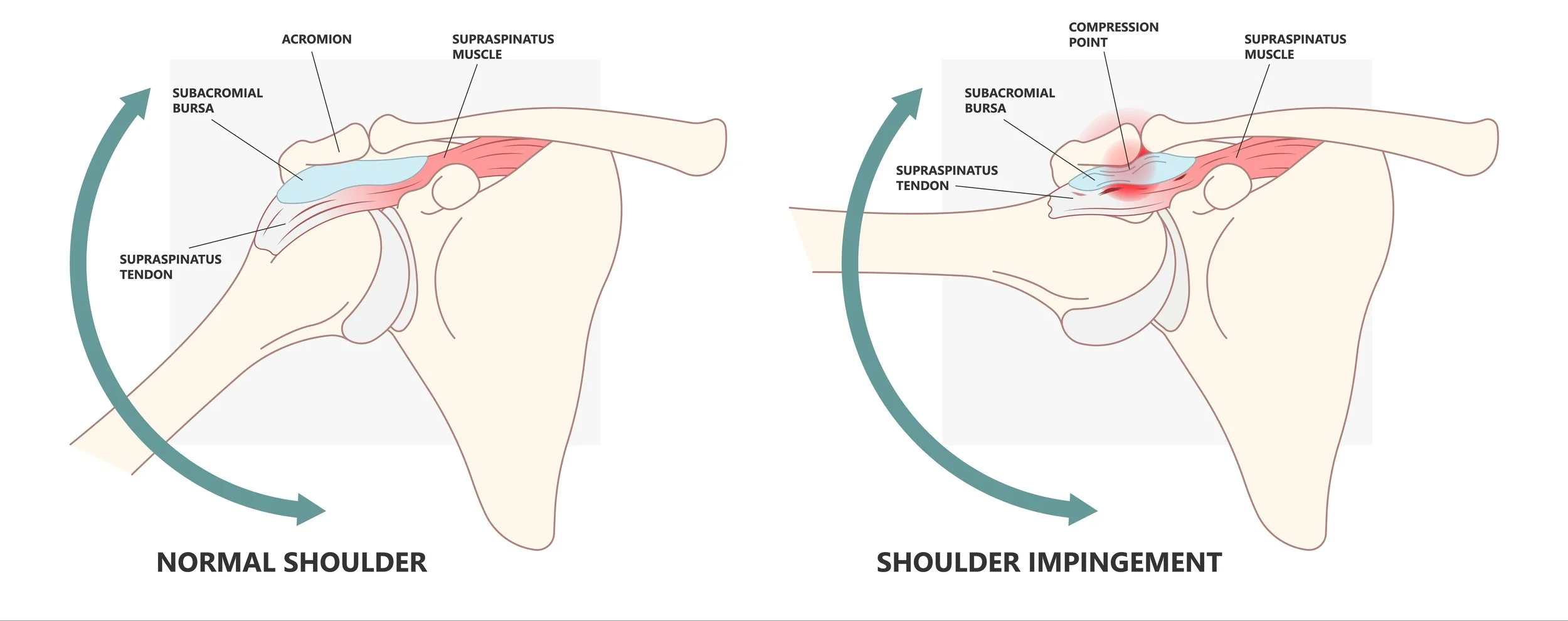
For patients in Richmond, VA seeking specialized care, understanding the mechanics of shoulder impingement is the first step toward recovery. Shoulder impingement (also called subacromial impingement, and not to be confused with subcoracoid impingement) is a mechanical problem where the "roof" of the shoulder (the acromion) rubs against the rotator cuff tendons underneath it.
Normally, there is a small space between the rotator cuff and the acromion. However, if you develop a bone spur on the acromion, or if the rotator cuff becomes inflammed, that space can close down. Every time you lift your arm, the tendon gets pinched between the acromion above it and the . Over time, this chronic rubbing can fray the tendon, leading to a rotator cuff tear.
To make the diagnosis, an exam is required and an MRI is helpful to rule out other conditions.
For more information on this topic, see the American Academy of Orthopaedic Surgeon's educational page here.
Symptoms
The "Painful Arc": Pain specifically when lifting the arm forward between 60 and 120 degrees (0 degrees is by your hip, 90 degrees is straight in front of you).
Reaching Pain: Sharp pain when reaching into the back seat of a car or putting on a coat.
Preserved Strength: Unlike a tear, the strength is usually normal, just painful.
Non-Operative Management
Medication: Anti-inflammatory medication can help alleviate the pain.
Cortisone Injection: Reduces the inflammation of the bursa/tendon, similar to oral medications but more targeted right at the location of the problem (subacromial space).
Physical Therapy: Helps strengthen the adjacent musculature, stretch any tight structures, and teaches the safe ways to perform overhead activities.
When is Surgery Needed?
Failed Non-Operative Management: If 3-6 months of conservative care fails to resolve the pain.
Surgical Solutions
Shoulder Debridement – An arthroscopic procedure to clean out any inflammed tissue and open the subacromial space.