PECTORALIS MINOR RELEASE
The Goal
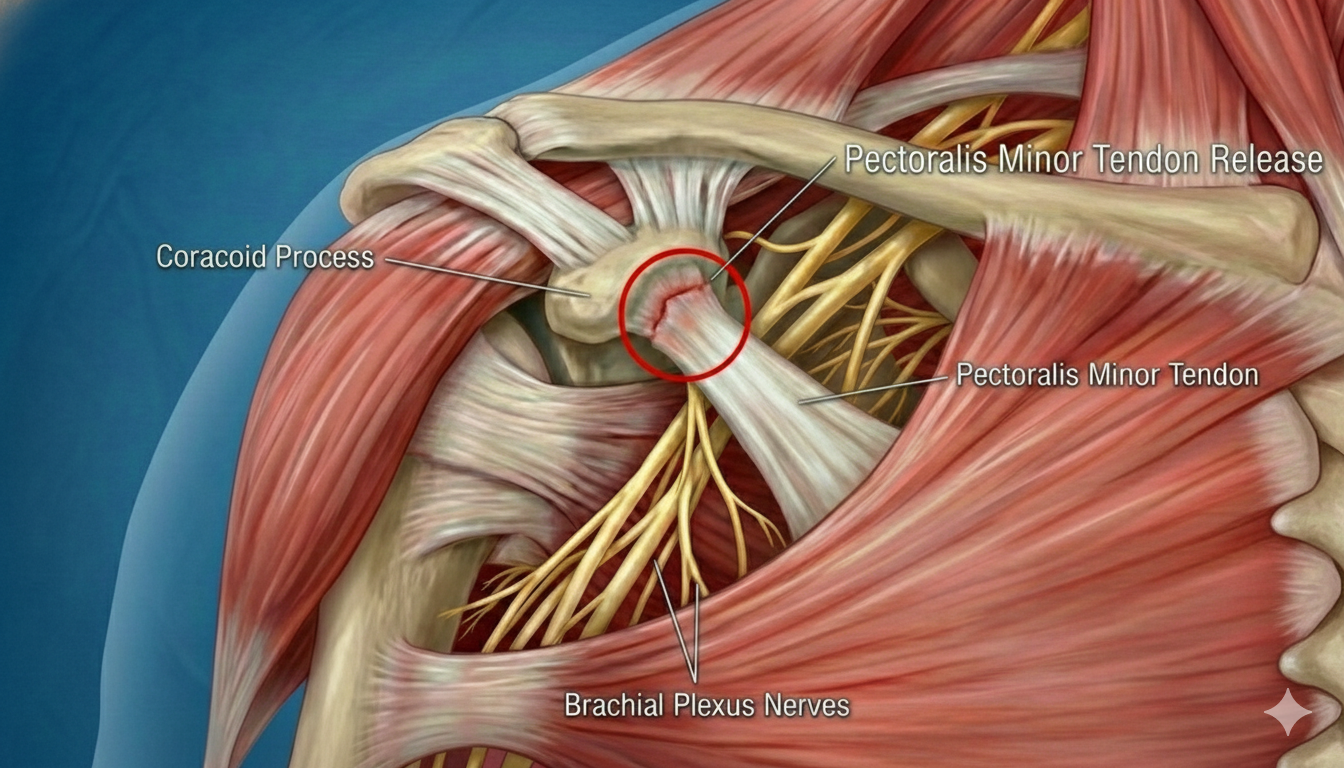
Dr. Kevin Wall provides specialized, fellowship-trained surgical treatment for Pectoralis Minor Syndrome and Functional Scapulothoracic Abnormal Motion (STAM) to restore posture and relieve nerve compression for patients in Richmond, VA, and the surrounding Central Virginia communities. The pectoralis minor is a small, triangular muscle in the front of the chest that attaches to the coracoid process of the shoulder blade. When this muscle becomes chronically tight or shortened, it acts like a tether, pulling the shoulder blade forward into a painful "anterior tilt" and potentially compressing the nerves running underneath it (a form of thoracic outlet syndrome). The goal of this procedure is to surgically release this tight muscle immediately allowing the scapula to rotate back into its healthy, upright position and relieving pressure on the brachial plexus.
This page is designed to educate you specifically about this procedure. Additional information that generally applies to most of Dr. Wall’s surgeries can be found on these pages:
The Procedure
This is typically an extremely fast, high-efficiency procedure with a rapid recovery.
The Technique
Arthroscopic Release: Most commonly, Dr. Wall performs this entirely arthroscopically (through small portal incisions). The tendon attachment at the coracoid is identified and precisely cut (tenotomy).
Instant Correction: Once the tendon is released, the downward force on the scapula is instantly removed, permanently correcting the mechanical imbalance without sacrificing shoulder strength.
Commonly Combined Procedures
While often curative on its own for functional STAM 1, the pectoralis minor release is frequently a critical step in larger reconstructive surgeries:
With Brachial Plexus Neurolysis: For patients with nerve pain traveling down the arm, releasing the pectoralis minor is the "un-roofing" step that physically decompresses the nerves of the brachial plexus. A neurolysis (removal of scar tissue/adhesions) around the nerves of the brachial plexus can then be performed.
With Scapulopexy (Rib Tethering): When reconstructing a functional STAM 2, it is essential to release the tight pectoralis minor in the front before tethering the scapula in the back. This ensures the shoulder blade can sit flat against the ribs without fighting against a deforming muscle in the front.
Post-Op Protocol
When a pectoralis minor release is performed by itself (or with just a brachial plexus neurolysis) no structural repair or reconstruction is performed (nothing is stitched back together) and so the recovery is determined solely by comfort. However, when a scapulopexy is performed as well, the rehabilitation must change since more tissue must heal safely. The following is the recovery protocol for a pectoralis minor release without a scapulopexy:
Immediate Motion (Phase 1):
Sling: Used for 1–3 days strictly for comfort. You are encouraged to discard it as soon as you feel ready.
Activity: You may use your arm immediately for daily activities like eating, typing, and dressing.
Range of Motion: Full motion is allowed and encouraged right away to prevent stiffness.
Physical Therapy:
Begins within the first week.
The Focus: Now that the "tether" is gone, therapy focuses on retraining the posterior muscles (Lower Trapezius and Serratus Anterior) to hold the scapula in its new, correct position.
Return to Play: Most patients return to full unrestricted activity, including sports and heavy lifting, within 3–4 weeks.
When to Seek Care
You should schedule a consultation if:
You have tenderness at your coracoid or pain in the front of your shoulder, especially if it radiates across your chest.
You have visible "anterior tilt" (your shoulder looks rolled forward) that you cannot correct even with stretching.
You experience numbness or tingling in your hand when your arms are overhead or when sleeping.
You have been diagnosed with "Neurogenic Thoracic Outlet Syndrome" or "Pec Minor Syndrome."