Adhesive Capsulitis (Frozen Shoulder)
Overview
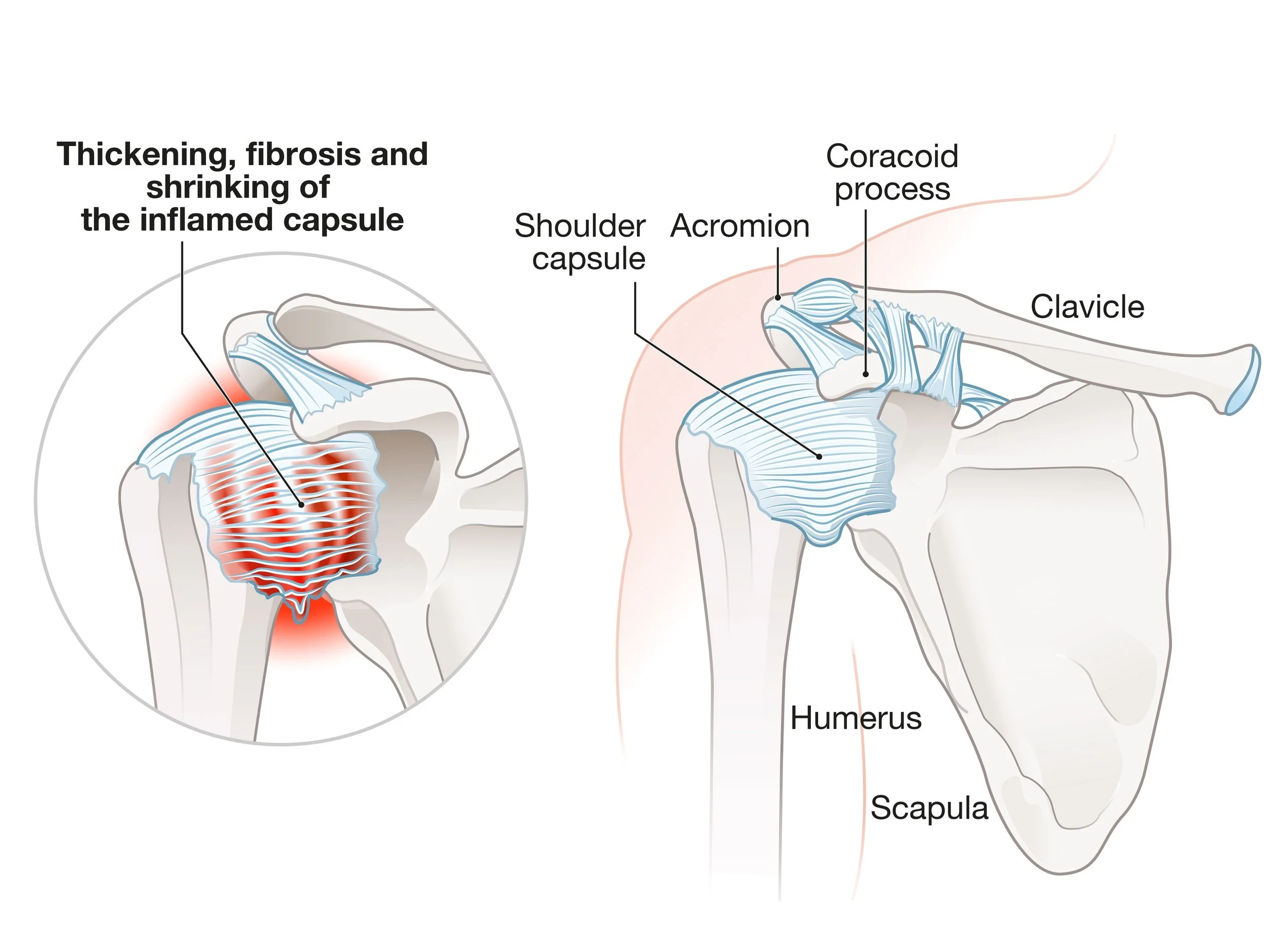
For patients in Richmond, VA seeking specialized care, understanding the mechanics of adhesive capsulitis is the first step toward recovery. Adhesive capsulitis, also called a frozen shoulder, is a distinct condition where the capsule (the flexible envelope of tissue surrounding the joint) becomes inflamed, thickens, and physically shrinks. It is not just "stiffness"—it is a fibrotic process where the shoulder capsule becomes tighter and tougher.
The condition typically moves through three phases:
Freezing: Severe, sharp pain and progressive loss of motion.
Frozen: Pain lessens, but the shoulder is incredibly stiff.
Thawing: Slow, gradual return of motion over the span of months.
Adhesive capsulitis is a long and painful process that can take up to two years to fully resolve but in most patients, it does fully resolve on its own without surgery. it can present similarly to other conditions such as rotator cuff tears and shoulder arthritis, both of which also demonstrate loss of shoulder motion. The difference in adhesive capsulitis is that a patient loses passive motion (when an external force, such as a doctor or your other arm, move the affected arm) without any other explanation. To make the diagnosis, x-rays, an exam and occasionally an MRI are used.
For more information on this topic, see the American Academy of Orthopaedic Surgeon's educational page here.
Symptoms
Mechanical Block: A hard stop to motion, like hitting a wall. You cannot force the arm up, even with help.
Jolting Pain: Sudden, excruciating pain if the arm is bumped or moved quickly.
External Rotation Loss: The inability to rotate the arm outward (like opening a door) is the key diagnostic sign.
Causes
Idiopathic: Often occurs for no clear reason, most commonly in middle-aged women.
Diabetes & Thyroid Disease: Patients with endocrine disorders are at higher risk.
Post-Surgical: Stiffness developing after shoulder, breast or chest surgery.
Non-Operative Management
Frozen shoulder is often a self-limiting condition, meaning it can resolve on its own, but it may take up to two years.
Medication: Anti-inflammatory medication often helps alleviate the pain
Cortisone Injections: May be more effective if given in the early "Freezing" phase to minimze inflammation.
Physical Therapy: Involves gentle stretching until it is painful. It can eventually be done at home but it is important to spend many sessions early on with a physical therapist due to how challenging this therapy can be. Aggressive cranking on a frozen shoulder often makes inflammation worse.
Dr. Wall attempts to combine all of these treatments at once. Physical therapy is usually better tolerated when the other treatments help lessen the pain first.
When is Surgery Needed?
If the shoulder remains stiff after 12 months of managed care and injections and the stiffness is intolerable for the patient's lifestyle. Improvement with just physical therapy and symptom management alone can be seen up to one year.
Surgical Solutions
Capsular Release – An arthroscopic procedure in which Dr. Wall cuts the tight capsule to instantly restore motion. This must be followed with immediate and sustained physical therapy. If not, shoulders often scar back down and freeze again.