Arthroscopic Distal Clavicle Excision
The Goal
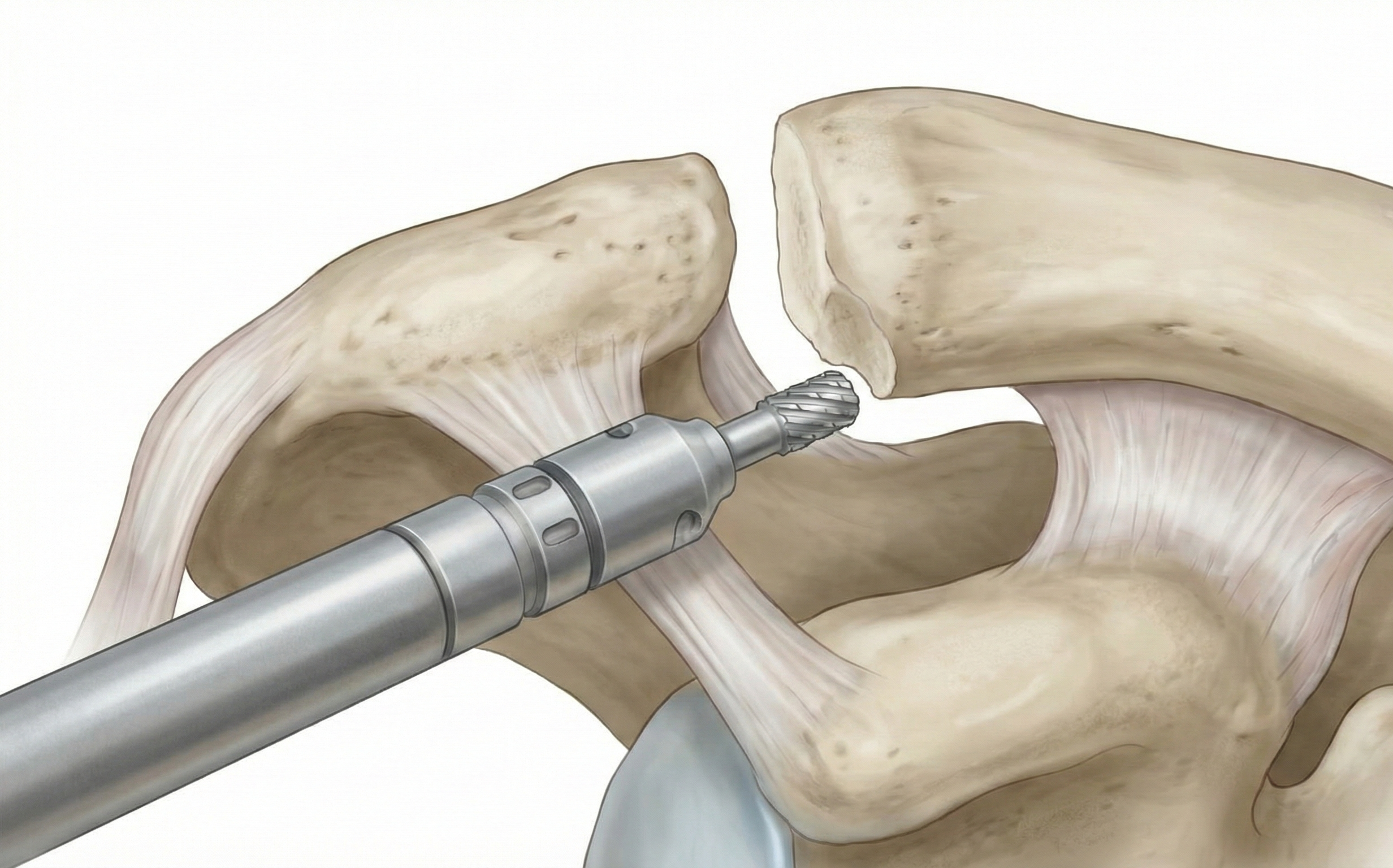
Dr. Kevin Wall provides specialized, fellowship-trained surgical treatment for Distal Clavicle Excision to restore function and relieve pain for patients in Richmond, VA, and the surrounding Central Virginia communities. The objective of this procedure is to alleviate localized pain at the acromioclavicular (AC) joint caused by AC joint arthritis. By removing a small wafer of the distal clavicle (the end of the collarbone), we eliminate the painful bone-on-bone contact that occurs during overhead movements and cross-body reaching, thereby restoring comfort and joint function.
This page is designed to educate you specifically about this procedure. Additional information that generally applies to most of Dr. Wall’s surgeries can be found on these pages:
The Procedure
The Approach: This procedure is performed arthroscopically using 2–3 small, minimally invasive incisions.
Bone Resection: Using a specialized high-speed surgical burr, Dr. Wall meticulously removes the arthritic distal end of the clavicle.
Ligament Preservation: The surgical technique is designed to create adequate joint space while strictly preserving the important surroudning ligaments, which are essential for maintaining AC joint stability.
Debridement: Any inflamed bursal tissue around the AC joint is also removed to further reduce post-operative pain
Post-Op Protocol
Start Formal PT: Professional physical therapy begins at post-operative Week 0.
Phase 1 (0–2 weeks): Initiate progressive passive, active-assist, and active shoulder motion as tolerated. A sling is utilized for comfort and should be worn at all times except during hygiene or performing motion exercises. Motion of the elbow, wrist, and hand is encouraged as tolerated.
Phase 2 (2+ weeks): The sling is discontinued. Rehabilitation focuses on achieving full active range of motion (AROM). Progressive strengthening begins only after full active range of motion has been established.
When to Seek Care
You should schedule a consultation if:
You have sharp, localized pain on the very top of your shoulder that is sensitive to the touch.
You experience a painful "grinding" or "clicking" sensation when reaching across your chest or behind your back.
Conservative treatments, such as activity modification or localized injections, are no longer providing sufficient relief for your AC joint pain.