Acromioclavicular (AC) Arthritis
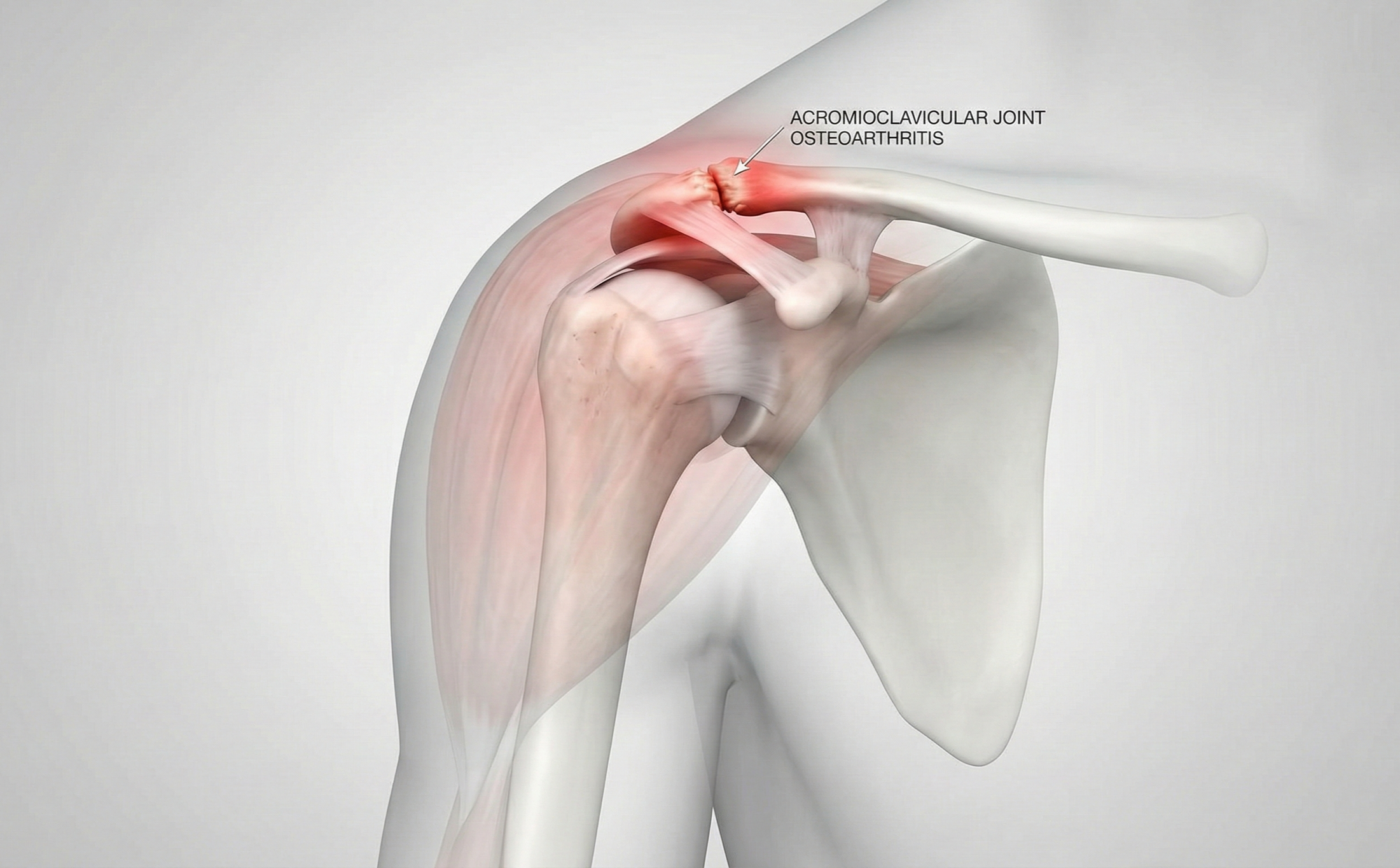
Overview
For patients in Richmond, VA seeking specialized care, understanding the mechanics of acromioclavicular (AC) joint arthritis is the first step toward recovery. The AC joint is where your acromion (part of your shoulderblade) meets your clavicle (collarbone). This joint is a small, high-pressure joint that contains a meniscus-like disk of cartilage. Because it serves as the pivot point for the entire arm, it can endure significant stress over the course of one’s life — especially during overhead lifting or cross-body movements.
Over time (or after repeated heavy loading), the cartilage wears away, leading to bone-on-bone contact. This condition occurs naturally with age and looks, and feels, similar to "Weightlifter's Shoulder" (Distal Clavicle Osteolysis) which is common in patients who heavily bench press. The diagnosis is usually made with an exam and x-rays.
Symptoms
Pinpoint Pain: The patient can usually point to the exact spot of pain with one finger—right on top of the shoulder at this small joint.
Pain with Cross-Body Motion: Reaching for a seatbelt, washing the opposite shoulder, or the completion phase of a golf or tennis swing.
Sleep Disturbance: Pain when rolling onto the affected shoulder in bed.
Causes
Post-Traumatic: Arthritis developing years after a minor AC separation.
Degenerative: Simple age-related loss of cartilage.
Distal Clavicle Osteolysis: Micro-fractures and resorption of the bone end caused by repetitive heavy loading (bench press, overhead press).
Non-Operative Management
Activity Modification: When this is exacerbated by weightlifting, avoid "dip" exercises and upright rows. Widening the grip on the bench press bar to reduce joint compression may also help.
Cortisone Injections: A targeted injection into the AC joint is highly effective for diagnostic confirmation and providing relief, occasionally permanently but usually for only 3-6 months.
Medications: Certain medications to alleviate pain may also assist with this condition.
When is Surgery Needed?
Failed Conservative Care: When the patient has altered their workout, tried injections, and still has pain that interferes with sleep or daily life or ability to play a sport they wish to play.
Concomitant Surgery: This condition is also often addressed during a Rotator Cuff Repair if the patient also has AC joint symptoms.
Surgical Solutions
Distal Clavicle Excision – An arthroscopic surgery in which just a thin wafer of the end of the collar bone is shaved off so the arthritis (and the pain of bone-on-bone) is removed.