Calcific Tendonitis
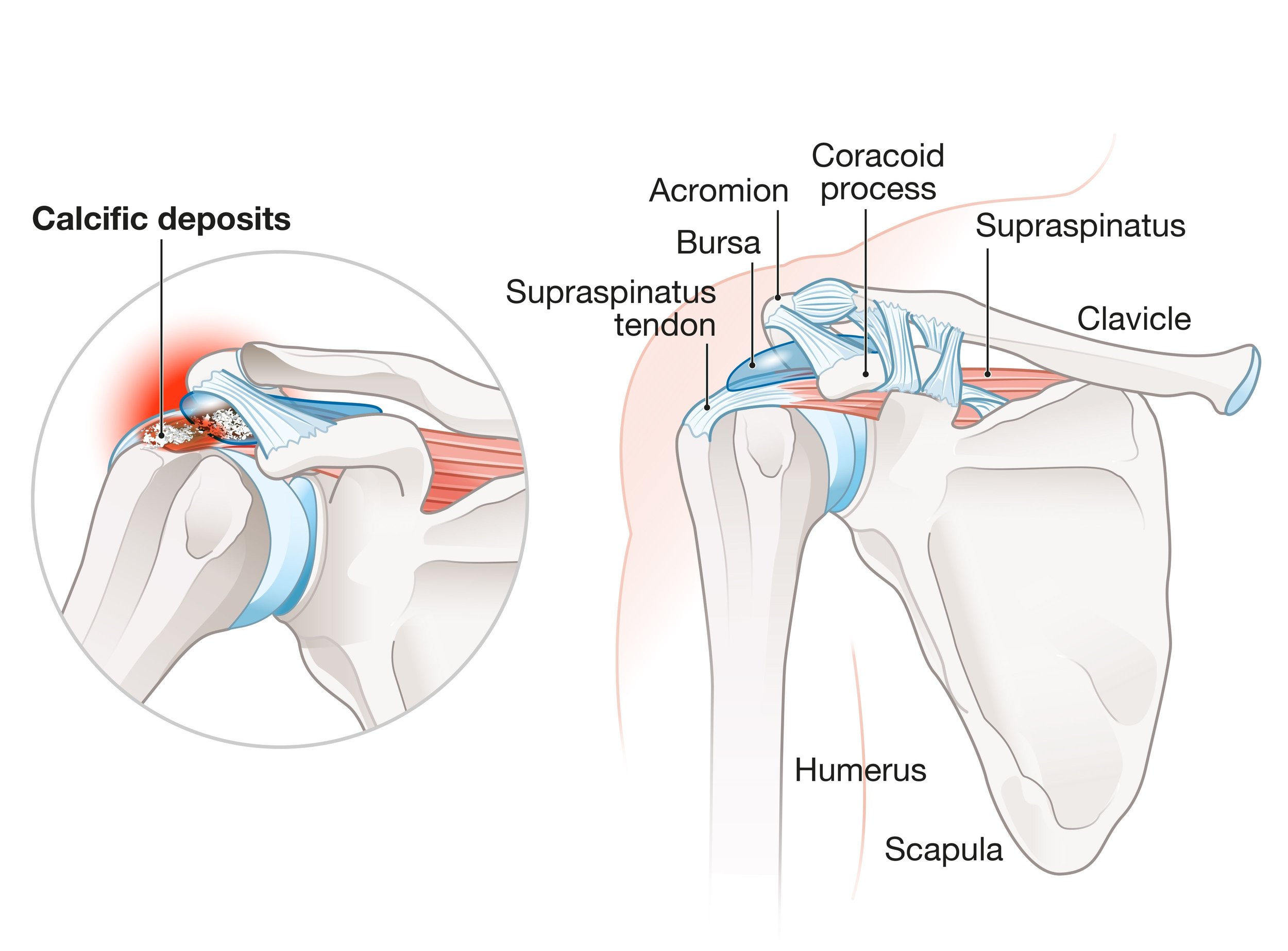
Overview
For patients in Richmond, VA seeking specialized care, understanding the mechanics of calcific tendonitis is the first step toward recovery. Calcific tendonitis is a unique and often intensely painful condition where calcium deposits form inside the rotator cuff tendons. Unlike bone spurs (which grow on the outside of a bone), this is a change within the tendon tissue itself.
The condition evolves in stages. The calcium forms silently (Formative Phase), sits dormant (Resting Phase), and then the body mounts an attack to dissolve it (Resorptive Phase). Paradoxically, the Resorptive Phase is the most painful part.
To make the diagnosis, x-rays are required to visualize the extra calcium sitting in the rotator cuff tendon, where there usually should be none.
Symptoms
Acute, Severe Pain: Patients often describe this as severe pain, unrelated to any injury, that comes on suddenly.
Inability to Move: The shoulder is often too painful to move, mimicking a frozen shoulder or infection.
Night Pain: Extreme difficulty sleeping due to the throbbing pressure.
Causes
Cellular Metaplasia: It is not related to dietary calcium or necessarily to an injury. It is a metabolic change where tendon cells mistakenly turn into calcium-producing cells. It is most common in middle aged women and can be associated with diabetes.
Non-Operative Management
Time & Anti-inflammatories: Once the resorptive phase ends, the pain often resolves completely as the tendon heals. Anti-inflammatory medication can help with the pain while it is present.
Steroid Injection: Just like oral anti-inflammatory medications, steroids also produce an anti-inflammation effect that may help with the pain.
Physical Therapy: PT may help with the pain by strengthening the surrounding muscles and ensuring the shoulder keeps moving and doesn’t develop a frozen shoulder.
Ultrasound-Guided Barbotage: A needle procedure to break up the deposit and lavage (wash) the calcium out if the above, less-invasive techniques do not work.
When is Surgery Needed?
Chronic Symptoms: If the calcium hardens and causes persistent pain or mechanical impingement (rubbing) that doesn't go away after the acute phase.
Failed Non-operative treatment: If medications, injections and barbotage fail to remove the pressure and pain.
Surgical Solutions
Shoulder Debridement – This is a generic arthroscopic procedure that is used for many different types of problems. It is when Dr. Wall uses small instruments to address a problem in the shoudler that just needs to be carefully removed. In this instance, it is the calcium deposit in the rotator cuff tendon. Sometimes during this procedure, other problems such as rotator cuff tears are noticed and need to be addressed as well.