Labral Tears & Instability
Overview
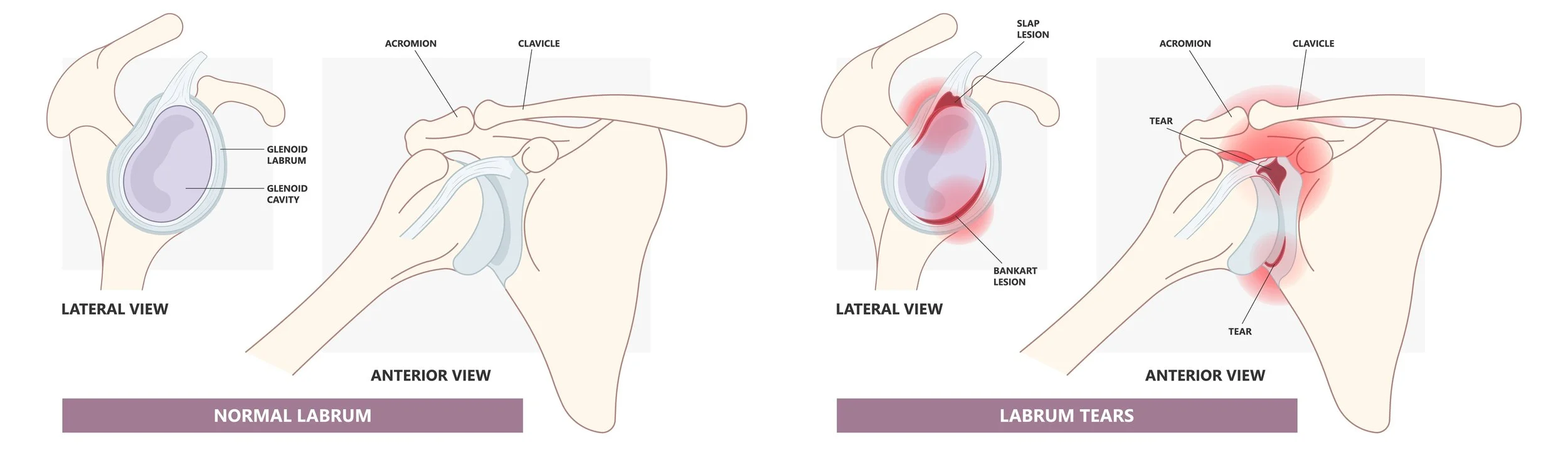
The shoulder socket (glenoid) is naturally flat, like a golf tee holding a golf ball (humeral head). To deepen this socket and provide stability, a rim of rubbery tissue called the labrum surrounds the edge. It acts like a bumper or a gasket, helping to deepen the socket and to keep the humeral head in place.
When the labrum tears, that humerus loses its bumper for that side of the glenoid. In young athletes, this typically happens during a traumatic dislocation (the ball popping out of the socket). This tears the labrum off the bone (a Bankart lesion), leaving the shoulder vulnerable to recurrent dislocations. In older patients, the labrum can fray degeneratively. In some injuries, the labrum and small piece of glenoid bone can break off together. Some of the supporting ligaments around the shoulder joint are also often injured. Depending on the direction of the forces at the time of the injury, these tears can occur on either the front (anterior) or back (posterior) side of the glenoid and can even extend from front to back.
Over time, if left untreated, these injuries may cause continued bone loss on the anterior glenoid. This further destabilizes the shoulder and may eventually change the type of treatment required. This can be thought of as the golf tee having a chip in it’s surface - the ball already sits on it precariously, if the golf tee loses some of its surface area, the ball will almost certainly fall off.
To make the diagnosis, a careful history and physical exam are first required, followed by MRI and sometimes CT.
For more information on labral tears, see the American Academy of Orthopaedic Surgeon's educational page here.
For more information on chronic instability, see the American Academy of Orthopaedic Surgeon's educational page here.
Symptoms
Pain: Can be persistently present but is usually only when the arm is put into a certain position such as overhead or straight ahead while holding an object.
Apprehension: A distinct, painful feeling that the shoulder is going to "pop out" when the arm is in a throwing position.
Weakness: In addition to pain, some patients, especially athletes, may notice unexpected weakness when using their arm, such as when throwing or hitting a ball.
Instability: In more advanced cases, patients can have ongoing, recurrent instability in which they can feel the humerus subluxate (slightly translate) or fully dislocate (completely leave the glenoid) during certain activities or even while sleeping.
Causes
Traumatic Dislocation: A fall or collision forcing the arm out of the socket (common in football, hockey, rugby).
Repetitive Microtrauma: Overhead athletes (pitchers, swimmers) stretching the shoulder capsule and weakening the labrum over time.
Non-Operative Management
Activity modification and medication: When it is possible to avoid the painful positions, doing so can help patients avoid surgery. This isn’t always possible if these positions are easily reached in day-to-day life or are required for one’s sport. Medication may help alleviate the pain as well.
Physical Therapy: Strengthening the "dynamic stabilizers" (rotator cuff and scapular muscles) to compensate for the loose ligaments and torn labrum.
When is Surgery Needed?
Recurrent Instability: If the shoulder dislocates more than once after a legitimate trial of physical therapy
Young Athletes: Evidence shows that young athletes have a high recurrence rate without surgical stabilization even after only one dislocation
Bone Loss: If repeated dislocations have worn away part of the socket.
Surgical Solutions
Labral Repair – An arthroscopic procedure to repair the labrum torn off the rim of the glenoid back to the bone where it belongs.
Latarjet Procedure – A bone block transfer for shoulders with significant bone loss or high collision risk.